
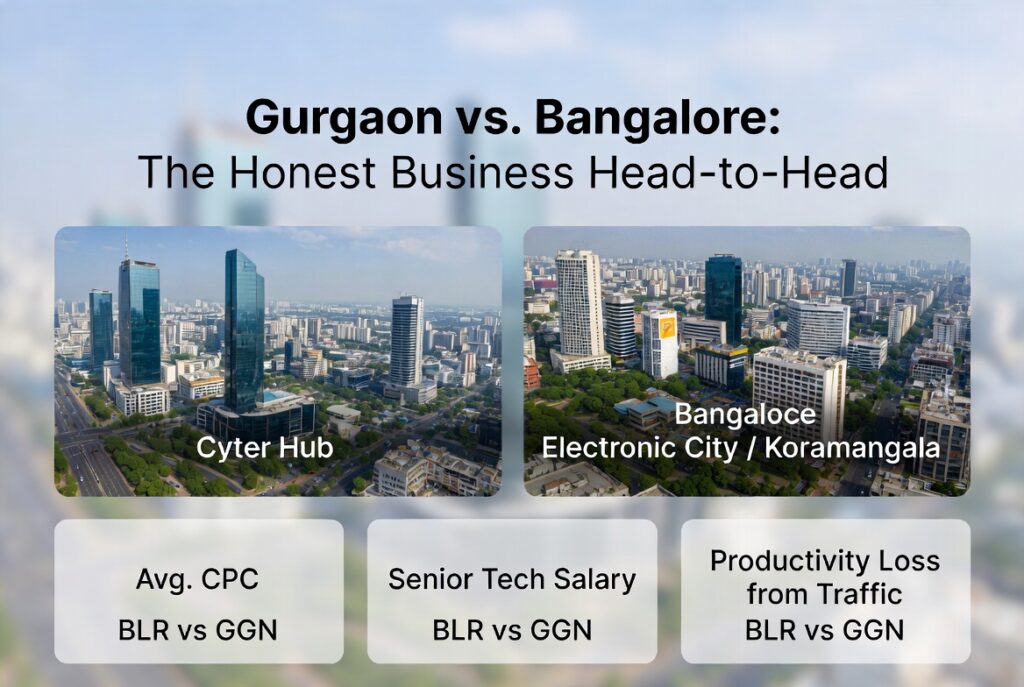
The Turf War: Gurgaon vs. Bangalore for Your Business Future
If you’re a founder or an executive planning a new office, the choice of city dictates everything: your talent pool, operational costs, access to markets, and even your digital strategy. In India, the comparison inevitably boils down to the two titans of tech and business: Gurgaon and Bangalore.
As you weigh the glass towers of Cyber Hub against the innovation hubs of Electronic City, the decision often feels paralyzing. Many companies rush into a location based on superficial factors like a single good rental deal or anecdotal evidence, leading to long-term operational and hiring nightmares.
This is your honest, critical comparison. We’ll move past the glossy brochures and analyze which city truly offers the better ecosystem for your growth, especially regarding your digital footprint and speed of scale.
The Problem: Making a Business Decision Based on Emotion
The biggest mistake executives make is letting a single, short-term factor—such as the CEO’s existing network in one city or a one-time real estate discount—dictate the location. Location is a long-term strategic decision.
You need to analyze Talent Acquisition, Cost of Operations, Market Access, and, crucially, the Competitive Digital Landscape. If you choose the wrong city, your marketing budgets will be wasted chasing talent and visibility in an overly saturated or unsuitable environment. This failure is a multi-year drag on your profitability.
5 Critical Comparison Factors: Gurgaon vs. Bangalore
Here is the honest head-to-head on the factors that truly impact a business’s ability to scale.
1. Talent Pool: Depth vs. Specialization
Bangalore (BLR) boasts the deep, generalist IT and engineering talent pool, driven by decades of established tech giants. However, this depth leads to intense competition and high attrition. Gurgaon (GGN) offers a more specialized, slightly less saturated pool, particularly in FinTech, consulting, and digital marketing.
Critical Takeaway: The Cost of Acquiring Top Talent
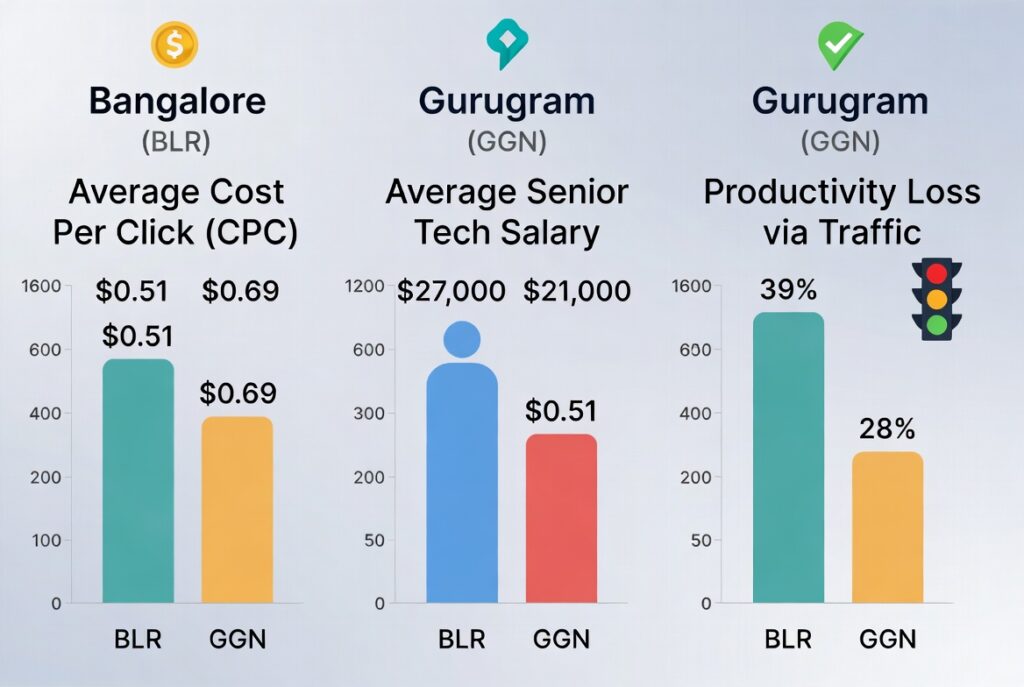
The cost of acquiring and retaining senior talent in BLR is notoriously high, with frequent counter-offers. GGN often provides slightly better stability and competitive salaries for specialized roles. If your strategy relies on advanced marketing techniques, you might find GGN-based support, such as high-quality SEO outsourcing in India, more focused on the NCR ecosystem.
2. Operational Costs: Real Estate & Infrastructure
BLR’s commercial real estate is vast, but the infrastructure struggles—especially the notorious traffic—add hidden, crippling costs via lost employee productivity and higher logistical complexity. Gurgaon, while also facing traffic challenges, benefits from better planned, contiguous business districts like Cyber Hub and Golf Course Road.
Critical Takeaway: Hidden Costs of Productivity Loss
A lower rent in Bangalore’s fringe areas might be offset by an employee’s daily 3-hour commute. GGN’s proximity to the Delhi airport and better connected business parks offers a higher concentration of resources, potentially leading to lower overall productivity costs.
3. Digital Visibility: Local Competition
Both cities have massive digital competition. However, Bangalore’s tech ecosystem means local searches (e.g., “best SaaS solutions near me”) are incredibly saturated, making it harder and more expensive to win local search visibility.
Critical Takeaway: The Price of PPC and SEO
The Cost-Per-Click (CPC) for high-value business terms is often significantly higher in Bangalore due to intense bidding wars between hundreds of VC-funded startups. In Gurgaon, while still competitive, a specialized Google Ads marketing agency in Gurgaon can often achieve a better return on ad spend (ROAS) by leveraging the specific density and consumer behavior of the NCR market.
4. Market Access: Regulatory & Government
Gurgaon benefits from its proximity to the national capital, offering easier and faster access to central government decision-makers, regulatory bodies, and major public sector enterprise clients.
Critical Takeaway: Strategic and B2G Advantage
If your business involves significant B2G (Business-to-Government) contracts, regulatory affairs, or national policy lobbying, Gurgaon provides an undeniable strategic advantage that Bangalore simply cannot match due to its geographical distance from Delhi.
5. Growth Culture: Stability vs. Hyper-Acceleration
Bangalore is defined by hyper-accelerated, often chaotic growth, favoring startups that can raise capital quickly and burn through it for rapid scale. Gurgaon, with a strong base of traditional industries, manufacturing, and consulting firms, offers a slightly more stable, cash-flow-conscious growth environment.
Critical Takeaway: Alignment with Your Business Model
If your model is “blitzscaling” and you need a high volume of talent now, BLR might work. If you favor sustainable, strategic, and controlled growth backed by strong local business infrastructure and less employee volatility, Gurgaon is the superior strategic choice.
Conclusion: The Strategic Choice for Your Scale
Choosing between Gurgaon and Bangalore is not about which city has more companies; it’s about which city provides the optimal environment for your specific business model, talent needs, and profitability goals.
While Bangalore offers a massive, generalized talent pool, Gurgaon provides strategic location, specialized talent in certain niches, and potentially better control over long-term operational and marketing costs. Don’t let a superficial advantage blind you to the hidden costs of poor infrastructure and hyper-competition.
Ready to build a winning digital strategy for your new city?
Partner with Max Growth Agency for a focused consultation that aligns your next phase of growth.

Deepika Bhardwaj is the Founder of Max Growth Agency, where she helps businesses scale through strategic SEO, high-impact Content Marketing, and authoritative Digital PR. With years of hands-on experience in building organic visibility and brand trust, Deepika specializes in data-driven growth strategies that consistently deliver results.